By Lily O’Delia
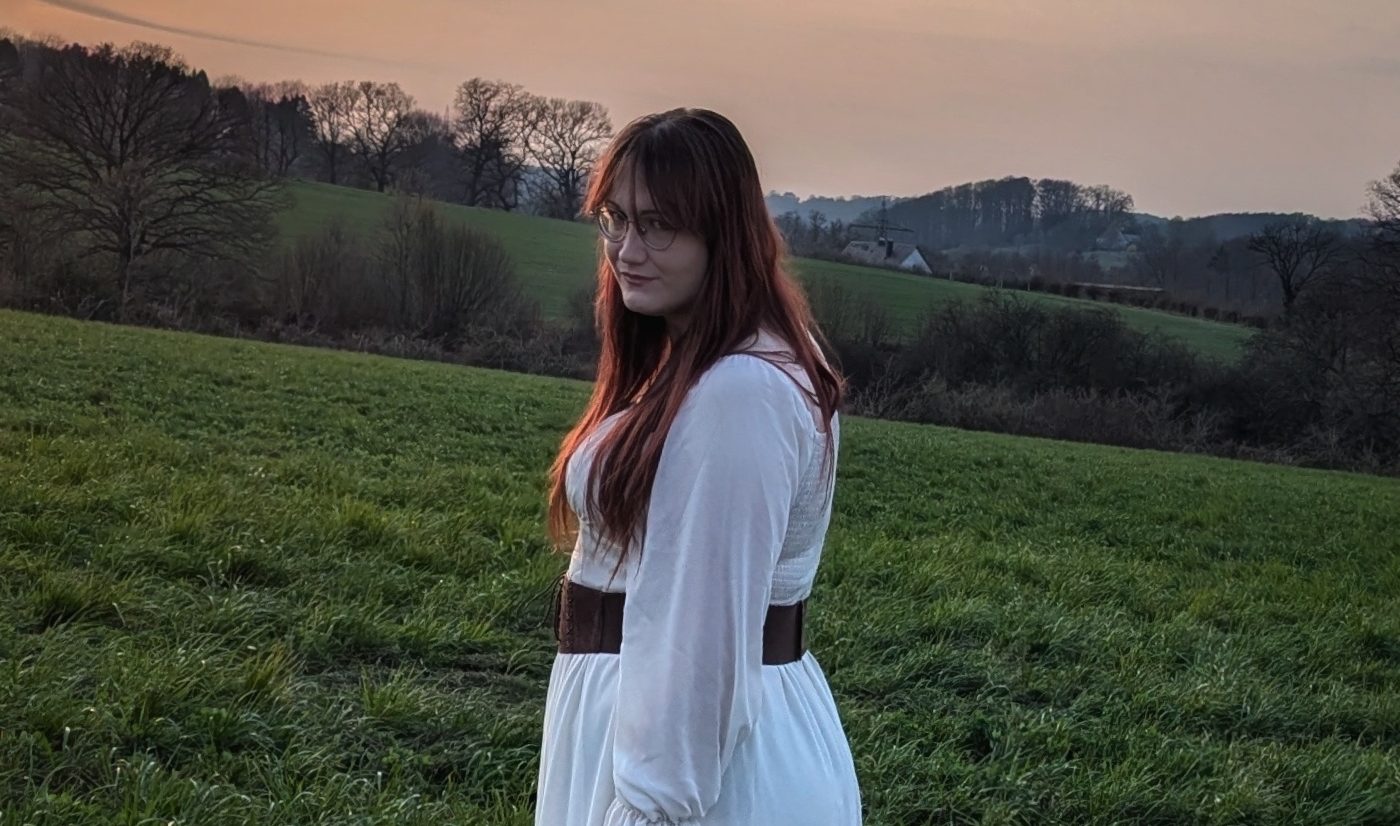
Vanessa Funke has spent the past several years developing a version of melodic death metal that leaves plenty of room for gothic atmosphere, black metal and electronic music. On her fifth album, Aura, those elements come together with some of her strongest songwriting yet. Across eight tracks, Funke handles every instrument and vocal herself, with Alicia Cordisco appearing for a guest guitar solo on opener “Last Dawn.”
There is an unmistakable early-2000s melodic death metal influence throughout Aura. The winding guitar melodies recall bands like Insomnium and Dark Tranquillity, but Funke brings synthesizers, clean vocals and a distinctly personal perspective into that foundation. The result feels expansive without losing the riffs that make melodic death metal so satisfying in the first place.
“Last Dawn” opens the album with an apocalyptic vision of a world approaching its final hours. At more than seven minutes, Funke gives the song time to develop, beginning with an ominous atmosphere before guitars and growled vocals take over. Melodic leads cut through the heavier sections, and Cordisco’s guitar solo gives the track another burst of melody. It immediately establishes the scale Funke is working with on Aura.
“Fading Memory” turns toward a different kind of loss. Its lyrics describe memories gradually disappearing until even the most important ones can no longer be held onto. Funke pairs that frightening idea with some of the album’s most memorable melodic guitar work. There is a strong contrast between the beauty of the lead guitars and the desperation in her growls, making the song one of the record’s early highlights.
The emotional center of Aura begins to emerge on “Coherence.” Funke writes about waiting years to feel at home in her body, only to discover that reaching that point can bring complicated emotions of its own. The repeated affirmation that nobody can take her validity away gives the song a sense of determination that grows stronger each time it appears. The guitars remain unmistakably metal, but melody carries much of the emotional weight.
“Infinite Skies” continues that sense of perseverance. Its expansive sound matches its imagery, with Funke allowing brighter melodies to enter the album without abandoning its darker foundation. Together, “Coherence” and “Infinite Skies” give Aura a deeply personal dimension. Funke is writing from her experience as a trans woman, addressing struggle and self-acceptance with unusual openness.
“Dead Souls” is the album’s longest song at nearly nine minutes, and Funke uses that space to create one of its most immersive pieces. The track deals with trauma and the way painful experiences continue to exist in memory long after the event itself has passed. Guitars, keyboards and vocals gradually accumulate around the song’s central melody, giving it a weight that matches the subject matter.
“Death’s Hand” brings the focus back to mortality. At just over four minutes, it is one of Aura’s more concise songs, pairing melodic death metal guitars with symphonic textures. Funke’s ability to layer melody into heavier passages is particularly effective here. The keyboards add depth around the guitars rather than competing with them, making the song feel larger than its relatively short runtime.
Then comes “Empty Heart,” one of the album’s biggest departures. Funke leans into her clean singing and love of ’80s textures, taking the record into power-ballad territory. Her mournful vocal performance reveals another side of her voice after the growls that dominate much of the album. The shift also makes “Empty Heart” immediately recognizable within the tracklist and shows how comfortably Funke can stretch beyond melodic death metal without losing the melancholy running through the record.
“Into the Night” closes Aura by bringing its different musical threads together. Heavy guitars meet keyboards and electronic textures as Funke alternates between aggression and melody. There is darkness throughout the song, but there is also defiance. After an album filled with questions of memory, identity and survival, its closing moments feel like a refusal to disappear.
That balance is what makes Aura so compelling. Funke clearly understands the melodic death metal tradition she is drawing from, particularly the emotionally charged guitar work associated with the genre’s early-2000s period. She also has enough confidence in her own songwriting to push beyond it. Synthesizers, gothic atmosphere, clean vocals and deeply personal lyrics all become part of the same musical language.
The fact that nearly every sound on Aura comes from one person makes its scope all the more impressive. Funke is a guitarist, vocalist and multi-instrumentalist, but Aura ultimately shows her strength as a songwriter. The technical ability is always serving the songs and the experiences behind them.
Aura is melodic death metal with an intensely human core. It can be furious and melancholy, then unexpectedly hopeful. Funke has taken the sounds that have influenced her and turned them into a record that feels personal at every level. By the time “Into the Night” reaches its end, Aura feels like a statement of survival from an artist increasingly confident in exactly what she wants to say.















+ There are no comments
Add yours