
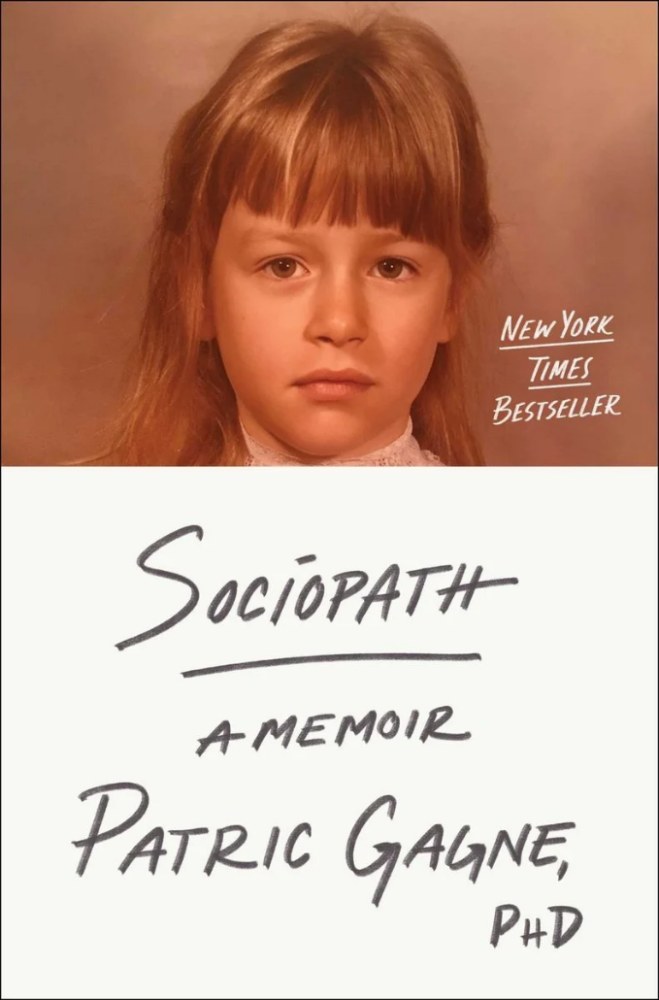

Sociopath: A Memoir by Patric Gagne review
By Lily O’Delia
There is something unnervingly intimate about Patric Gagne’s Sociopath: A Memoir, At one point, she writes, “For the most part, I felt nothing.” The line lands with a stark, almost clinical honesty, and it quietly becomes the pulse of the memoir. It beats beneath every chapter, shaping the choices she makes and the emptiness she spends years trying to outrun.
After causing serious harm to a classmate, Gagne begins searching for ways to make her apathy dissipate, no matter how dangerous or destructive those methods may be. She views her methods as a form of harm reduction. She sees it as a way of keeping herself from committing worse acts. Theft, risk, and transgression become less acts of rebellion than attempts to fracture the emotional numbness that defines her interior life. The book’s real force lies in that search — not in sensationalism, but in the frightening loneliness of existing at a remove from emotions most people experience instinctively.
The memoir takes a profound turn when Gagne reaches college and begins studying psychology. It is there that what she has long sensed about herself finally sharpens into language: she comes to the realization that she is a sociopath. Rather than letting that diagnosis calcify into hopelessness, she turns toward it with fierce intellectual clarity, eventually pursuing psychology as a way not only to understand herself, but to help others like her. That decision becomes one of the book’s most moving transformations — the woman once haunted by her own darkness choosing to use her degree to help fellow sociopaths navigate a world that has long rendered them as monsters.
Just as compelling is the memoir’s love story. Her relationship with David offers the book one of its most human and tender dimensions. He is not written as a savior, but as someone who sees her fully — including the parts of herself she fears most — and does not turn away. His acceptance of her darker side gives the memoir an emotional complexity that complicates the label at its center. Their relationship becomes proof that love can exist even within moral and emotional ambiguity. As critics and summaries of the memoir note, David becomes one of the few constants through whom Gagne experiences a deeper form of connection.
One of the memoir’s most revealing passages comes in a conversation with her father:
“You know what it’s like,” I said. “It’s like having bad eyesight. I can see most stuff, but there are some things that I have to squint to read. It’s the same with emotion. Happiness and anger — those are clear. They come naturally. Other ones don’t. Things like empathy and remorse — I can connect to them if I really try — but it doesn’t happen on its own. Sometimes it doesn’t happen at all.” I frowned. “I really have to squint.”
This remains the emotional center of the memoir. The metaphor is devastating in its simplicity. Rather than framing herself as monstrous, Gagne presents emotion as something partially obscured — visible, perhaps, but only through effort and strain.
Published in 2024, the memoir quickly became a bestseller, and its success feels rooted not in shock but in candor. What lingers is not simply the diagnosis, but the story of a woman who turns self-recognition into purpose, and darkness into something that can still hold love, work, and meaning.
Sociopath: A Memoir is, ultimately, as much a memoir of becoming as it is of confession.
Sent from Proton Mail for iOS
B696C3FA-F6EE-4CF5-82CA-663B5A4BD134.jpg