
Review BY Halina Wagner
Progressive rock has always been a home for ambition, imagination, and fearless commentary—but few modern bands deliver all three with the cohesion and conviction of Little King. Their latest album, Lente Viviente, arriving as a tightly packed 25-minute odyssey, is a masterclass in how to build something vast within a compact frame. Each track hits like a self-contained “micro-epic”, yet the record flows with the unity and emotional punch of a full-length concept piece.
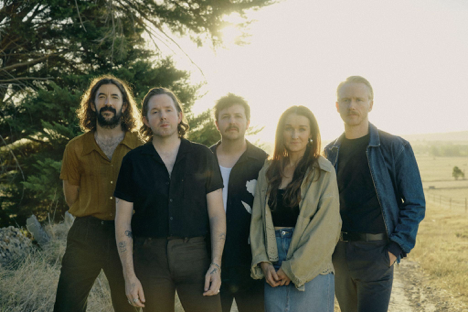
Frontman Ryan Rosoff has long been the creative engine behind Little King, but this time he’s joined by fresh blood—Dave Hamilton (bass) and Tony Bojorquez (drums)—a pairing that immediately reshapes the band’s rhythmic DNA. The newfound interplay is fluid, dynamic, and confidently complex, giving Lente Viviente its heartbeat. Their chemistry drives the album’s masterful shifts between prog flourishes, melodic introspection, heavy rock grit, and moments of almost cinematic tension.
At the album’s centre sits “Who’s Illegal?”, one of Little King’s most daring compositions to date. Built on alternating time signatures—6/8 crashing into 9/8—it mirrors the lyrical push and pull between division and unity. Inspired by Rosoff’s time in Tucson and the layered histories of its Presidio, the song asks a question that feels both ancient and urgent: who actually belongs? Its melodic basslines, suspended chords, and sharp, socially charged storytelling make it one of the record’s defining statements. The accompanying video, shot across Tucson’s textured landscapes, brings the themes of migration, inclusion, and identity into sharp visual focus. It’s bold, human, and unmistakably Little King.
But Lente Viviente is far more than one standout track. “Catch and Release” opens the journey with bright nostalgia and moments of playful rhythmic misdirection, laying the groundwork for the album’s emotional ebb and flow. “Dawn Villa” picks up that thread, moving deeper into memory and friendship with warm harmonics and tightly woven melodies.
Rosoff’s gift for blending vulnerability with storytelling is clearest on “Pass Through Filters”, where reflections on ageing and addiction rise through spiralling arrangements that never quite settle—mirroring the instability of the themes themselves. “Kindness for Weakness” taps into a similarly personal vein, tackling the modern misunderstanding of empathy through riffs that climb and collapse in equal measure.
“Sweet Jessie James”, the album’s shortest track, acts like a lightning bolt between heavier emotional chapters—quick, sharp, and loaded with attitude—before “The Living Lens” closes the record. It’s a fitting finale: patient, dynamic, and rich with the perspective of someone looking back at the world through years of scars and growth. The title’s translation, “living lens”, becomes a metaphor for the album’s core, reminding us that identity is always refracted through memory, experience, and the stories we choose to carry forward.
Across its 25 minutes, Lente Viviente becomes everything progressive rock should be: thoughtful without pretension, musically adventurous without losing melodic grounding, and emotionally raw without sacrificing technical polish. Rosoff’s background in creative writing is woven through every lyric and structural shift, but it’s the band’s collective performance that elevates these ideas from concept to impact.
With echoes of Rush, Porcupine Tree, and even the grand atmospheric tension of early Pink Floyd, Little King builds on prog traditions while carving out a voice unmistakably their own. After nearly three decades of growth, Lente Viviente stands as their most complete and compelling statement—short, sharp, deeply human, and endlessly replayable.
Little King hasn’t just released an album; they’ve crafted an immersive, emotional journey that rewards every listen.












+ There are no comments
Add yours