
by Lily O’Delia
For three decades, Seth Faergolzia has treated creation as his calling. A key figure in New York’s anti-folk and DIY underground. His extensive work—including Dufus, 23 Psaegz, Forest Creature, and Multibird—acts less like a typical discography and more like a living ecosystem. His songs are strange, funny, fragile, chaotically beautiful, and deeply heartfelt offerings, not just simple statements.
Faergolzia has never pursued genre, trends, or even consistency across his projects. Instead, he relies on something closer to instinct or faith. He allows music to come to life as it should, whether through wild art-school improvisation, communal choirs learned entirely by ear, or a film he has been crafting for twenty years.

This openness makes his work difficult to categorize but deeply impactful, especially during live performances, that often feel more like rituals than concerts.
As he gets ready for a new tour, continues with his solo projects, and finally finishes his film Moon Shaped Head; Faergolzia reflects on creativity as a spiritual practice. He discusses how challenges have shaped his perspective, the balance between instinct and revision, and why—despite decades of recorded work—he believes the best way to connect with his music is simply to be present in the room at one of his shows.
Your projects—Dufus, 23 Psaegz, Forest Creature, Multibird—each feel very distinct. How did they come into being, and what did each fulfill creatively?
Dufus was born out of wild improvisation with weirdos at art school. It was the center of our creative pool at the time, allowing for all to act as freely as they wished without fear of judgment.
23 Psaegz was made for the music score of the film, Moon Shaped Head, which I’ve been working on for the past 20 years. It was meant to do just that piece of music but became a band instead.
Multibird was born out of my 100 Songs project. I had so many songs that I asked members of 23 Psaegz, who were the core rhythm section at that time, to help me record them. Eventually 23 Psaegz fizzled out, and Multibird became its own thing.
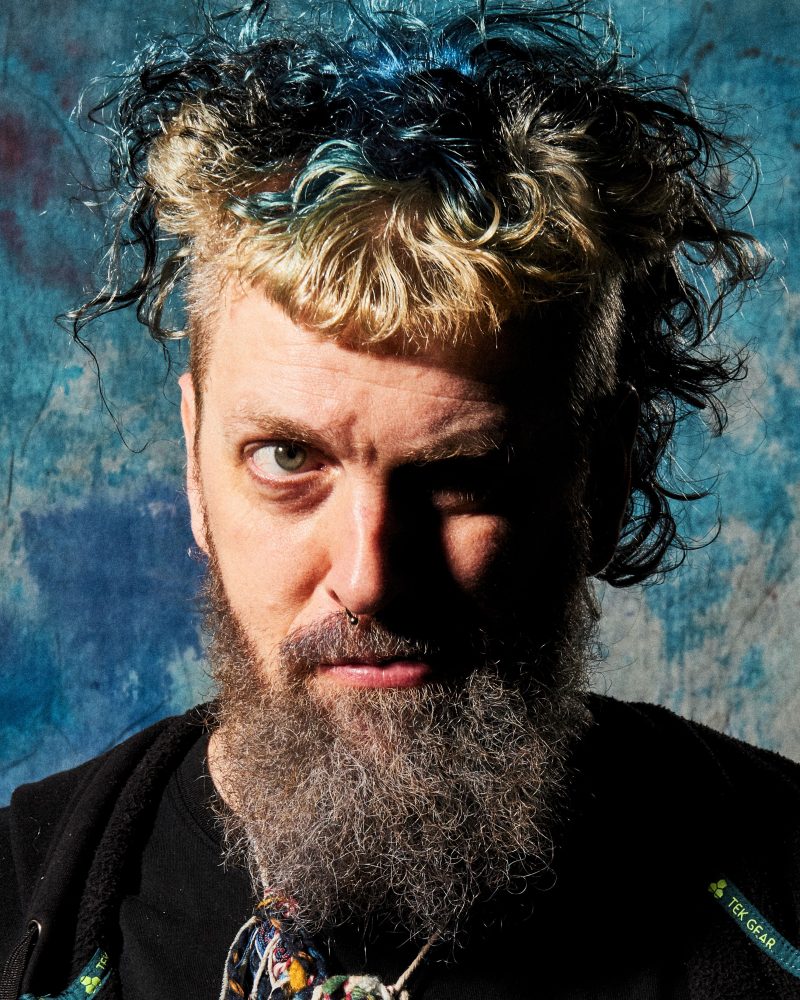
Forest Creature is a collaboration between myself and longtime musical influence John Ludington.
What usually comes first for you: sound, lyric, or feeling?
There really is no “usual.” A lot of the time, everything just spills out in a short burst. Some of my best songs took five to twenty minutes to birth the idea, and then months of honing afterward.
How do you balance instinct versus revision?
I used to be very strict about the purity of the first spark. Now I like to shine and polish—to remove parts I don’t like and replace them with clearer meanings. With recording, or anything that allows editing, I spend way more time than I should trying to perfect things.
Are there songs that surprised you by becoming something different than you intended?
“Fun Wearing Underwear” has developed enormously over the years. It started as the main theme of the musical of the same name. Over time, it became an audience singalong and fan favorite, and more recently it inspired my choir, Hopefully.
Your music has such a strong sense of texture and atmosphere. What influences shape that?
Influence is such a hard question. We’re deeply shaped by our earliest years, even though we don’t consciously remember them—hearing music on the street, playing in school band, being in punk or metal bands as teenagers.
I even spent a couple of years refusing to listen to recorded music at all. If I needed music, I played it. I was searching for my own voice, and I still feel like I’m finding it. It’s an inward journey. That said, I love listening to music, especially things I wouldn’t think to make myself. Music that touches mystery.
Has your relationship with genre changed over time?
I try to avoid genre whenever possible. Thinking about it can really kill creativity. I prefer to make the thing first, then decide later whether it’s meant to be shared or kept as a diary entry.
We were introduced by Choking Victim bassist Shayne Webb. How did you two meet?
Shayne feels like a big brother to me. We met when his girlfriend was in the musical Fun Wearing Underwear. It was absurd and wild—Shayne was always there in the doorway, carrying his vibe.
We became close, along with Josh Gura from C-Squat. Eventually, I moved into Shayne’s place there for about a year and a half. It was a turbulent time. I became ill and had to leave New York for quieter surroundings.
When I saw you live, the performance felt almost spiritual. I was struck by your stage presence and brought to tears. Is playing live as cathartic for you?
Most of the time, yes. When I’m able to overcome my fear of humans and really open up, it feels right.
How does performing songs live change your relationship to them?
Over the years, memories attach to certain songs. When you play them, you see other places and other people, and the music becomes more loaded with the energy of the years. You give it to people, and you receive their healing in response.
Sometimes a song loses its pull for me—even ones that really reach audiences—just kind of fall away. Some, though, have stayed with me over the years. Those seem to be the true ones.
How have European audiences differed from U.S. audiences?
I wish I toured the U.S. more. Europe became financially viable for me early on, and then I had a kid two years later, so I stuck with what worked. Touring the U.S. would mean building from the ground up again. Europe just feels more livable—maybe because my music is a little odd.
You’ve described creativity as a form of religion. What do you mean by that?
I believe a lot of things, and they change day to day. But creation feels spiritual to me. I find it’s the most healing thing I can do for myself and for others, using my inborn skillset.
Has your view on music’s role in social change shifted?
I was much more literal in the past. I think I believed I knew what was right and wanted to spread that belief. Now, I feel that I know what is right for me, and I focus on achieving that. I write music from my own experience in the hope that, by going through a process of positive change, I might touch on deeper answers in an unconscious or subconscious way and bring that same revelatory spirit to the hearts of listeners.
How do you feel when listeners project their own stories onto your songs?
I purposefully leave my lyrics vague so that listeners may find their own meaning. If you read poetry with two different mindsets, you’ll often see different meaning.
What makes collaboration work for you—and what shuts your creativity down?
Talking things through too literally shuts me down. Conscious decision-making can kill the magic. I like silence and unspoken understanding. Let the art speak.
How important is your local music community to your work?
Very important. That’s why we put a stop to Dufus. I had moved out of NYC and couldn’t bear to spend months working on songs and then go down and have two rehearsals with the new material for a performance. I like to deepen my bonds with people I work with. It’s not just the notes—it’s the social connection.
How has becoming a parent changed you creatively?
It taught me to let go of selfishness. Releasing attachment to my desires for the work allows it to create itself more freely.
How has adversity shaped your worldview?
Adversity has been my greatest teacher. I’ve seen wealthy people deeply unhappy, and very poor people completely content. I’ve had years of illness, even near death. Each time, I come away with a deeper appreciation for what I have.
You often write and direct your own music videos. Why is visual control important to you?
I like starting with a plan, but every plan is really just a sketch for improvisation. Moon Shaped Head is the ultimate example—twenty years of adapting to reality. I plan to finish it this year, no matter what shape it’s in.
What have you had to unlearn as a musician?
I went to music school, but I was in that state of unlearning even in the classes there. To me, thinking of notes by name is ugly; I prefer to think of the sound itself. Of course, we need to communicate these things, so I do use some music theory to share ideas.
Do you ever feel pressure to evolve?
I think the opposite. I always feel evolution happening, and I’m always writing. Jeffrey Lewis, a good friend and musician, often tells me I should include “the hits” in my live set, but my issue is that I usually only feel connected to the new material, so I often leave good songs from the past behind.
When did you realize your music was reaching people in a real way?
When I was living in C-Squat, my friend Popeye introduced me to Dufus’ manager, Anthony, who was also the manager for Bad Brains. He got us committed to ROIR for a record deal. I was invited on bigger tours, and things really seemed to be happening.
It was around that time that my chronic illness started, and despite a huge desire to get out there and ride the wave, I had to sit, think, lie down, and recover. It was challenging to see all my friends out there, but like I said, adversity has its teachings—it just wasn’t what I wanted.
You sang in church choirs as a kid and now lead a secular community choir. What connects those experiences?
I’d say growing up singing in choirs taught me the benefit of singing with others. There’s something so pure about bringing voices together. It’s nourishing. Hopefully Choir came also out of a post-pandemic need for community.
Anti-folk was about tearing down hierarchies between artist and audience. Does Hopefully Choir feel like a continuation of that ethos?
I think so. I’ve tried to create music for this group which is non-exclusive. No sheet music. Everything is learned by ear with texts. There’s no audition process, so we have all levels of singer.
What are you chasing creatively right now that you haven’t quite caught yet?
Moon Shaped Head, my puppet opera film.
Where should new listeners begin with your music?
Honestly, at a show. I never feel quite represented by
recorded work.
Dragon House was Multibird’s second release on Needlejuice Records. What drew you to them?
They’re an awesome label. I’ve discovered Lemon Demon through them. One of the label owners started coming out to the house shows I hosted here in Rochester. After a while, he mentioned he was with a label and asked if I’d like to put out some records with them. It’s been a great help these past few years—though I still wish I had a booking agent. That’s my least favorite part of my job.
You’ve been relentlessly prolific across decades—bands, solo work, choirs, visual art. Was that creative drive always there for you?
Yes, I’ve always needed to express, for as long as I could remember. Without it, I feel empty. I can remember, as a child, laying down for bed at night and having to turn the lights back on and get up repeatedly to write down thoughts.
What’s next?
An East Coast tour in February, solo album recording and mixing, Europe in June/July, then I’ll be focused on finishing my film, Moon Shaped Head.




+ There are no comments
Add yours